
Previous Residents at a Rocky Mount Address
The best source changes with the time period. A recent deed can point to a prior conveyance, while a historic directory can give a dated address-to-householder clue. Rocky Mount’s two-county footprint matters at every era. Resolve Nash or Edgecombe before opening an index, because the two Register of Deeds systems have different online routes and certified date statements. Treat every result as one piece of a dated address history, not a statement that someone stayed there without interruption.
| Source | Years it covers | Where held | What it can show |
|---|---|---|---|
| Nash real-estate records | From 1777; online deed lead identified for 1777-1969 | Nash Register of Deeds and Cott/index guide | Recorded parties, legal description, book/page, and deed trail |
| Edgecombe real-estate indexes | 1973-1994 pre-95 series; 1995-present consolidated real property | Edgecombe Register of Deeds Cott route | Certified index coverage and recorded real-estate trail |
| Rocky Mount city directories | 1908-1965, with gaps; 1930 first confirmed street-address year | Braswell Memorial Library, UNC Wilson, and DigitalNC | Dated name, address, householder, and directory details |
| Sanborn maps | 1885, 1891, 1896, 1901, 1907, 1912, 1917, 1923, 1949, 1956 | Library of Congress and HPO references | Building and street context before current parcel systems |
| Newspaper and archive leads | Title-specific runs; Nash Archives 1778-1909 | State Archives and Braswell research routes | Notices, events, relationships, and historic context |
Begin with the most recent parcel and move backward until the record type changes. A house that predates formal street-address listings may require a legal description, map sheet, or neighborhood clue before a directory can be used. Note: Keep the source date beside every address, name, and relationship in the working record.
Choose a Rocky Mount County Before Deeds
Rocky Mount crosses Nash and Edgecombe counties, so the postal city cannot choose the recorder. Verify the county with the parcel PIN, legal description, GIS parcel boundary, or deed reference. Nashville is the Nash seat and Tarboro is the Edgecombe seat. The 1871 railroad tracks became the official county boundary in the city’s historic planning narrative, which can explain why a street trail near rail corridors needs a second county check.
Use Nash Tax Search or the Edgecombe Parcel Search to collect the current parcel detail first. Edgecombe’s card separates Property Address, Current Owner, and Owner Address. A tax mailing address may be a post office box, business office, trust, or other destination. It does not make the addressee a past resident of the parcel.
Trace Rocky Mount Previous Residents Through Deeds
The deed chain is the ownership spine for previous-resident research. From the current parcel card, record the legal description, deed book/page, date recorded, and current owner. Open the deed image or index and locate the grantor, grantee, prior instrument reference, execution date, recording date, consideration if shown, and restrictions or easements. The prior book/page is more reliable than a street number when the road name or numbering changed.
- Identify the county and save the parcel ID or PIN, legal description, current owner, and deed book/page.
- Open the current conveyance in the county Register of Deeds index or office record and record each party’s role.
- Use the seller’s earlier acquisition or the instrument’s prior reference to find the next deed backward.
- Compare lot, subdivision, acreage, road name, and legal description across each step before treating it as the same property.
- When a transfer involves an estate, spouse, trustee, or organization, look for the named probate, vital, or county record as a separate dated lead.
- Grantor
- The person or entity transferring an interest in the recorded instrument.
- Grantee
- The person or entity receiving the interest in that instrument.
- Chain of title
- The sequence of recorded conveyances used to follow ownership of the same property backward.
- Legal description
- The lot, block, subdivision, acreage, or metes-and-bounds description that identifies land beyond a changing street address.
Nash Previous Residents Before 1970
Nash County states that real-estate records date to 1777 and identifies deeds from 1777 through 1969 as an online record-search lead. Its index instructions split the route at 1970. Books 874 forward use the 1970-to-present quick-name or advanced-search guidance. Books 873 and back use online index books. All plats are searched under Book/Page. Keep those branches separate when reconstructing prior owners of a Rocky Mount address.
The online Cott interface was not available for complete field inspection. If the index is unclear or an image cannot be confirmed, the Nash Register of Deeds provides the office route and says real-estate hard copy is available there. A deed party is part of a property transaction, not proof that the party lived at the address.
Edgecombe Previous Residents Before 1995
Edgecombe’s certified-date page divides real-estate index coverage differently. The pre-95 real-estate series runs from September 1, 1973 through December 31, 1994, while the consolidated real-property range begins January 1, 1995. Use the Edgecombe certified dates as the coverage check before relying on a search result. The county also warns that an index or released image can appear days before the image is available, and the official office record controls if there is a conflict.
The Edgecombe Cott route offers guest access or login, but the exact live search fields were behind that flow in the reviewed sources. For a record outside the online range or a disputed result, use the Edgecombe Register of Deeds office route in Tarboro rather than filling a gap with an inferred name or address.
Pair Rocky Mount Residents With Census
Directories add a household layer to the deed chain, but they must be read by edition. The official historic survey places Rocky Mount city directories from 1908 through 1965 at Braswell Memorial Library and UNC Wilson Library. It identifies 1930 as the first year with street-address listings. The run is sporadic through 1960 and nearly annual after that, so do not assume an entry exists for every year. The 1963 directory’s householder and street guide is especially useful for linking an address to the adult householder or concern listed in that edition.
For each directory year, record spelling, spouse or parent where printed, occupation, address, telephone, and the publication’s own home or rooming notation. Then compare the same period with the federal census through official archival or authorized genealogy access. Federal census material follows a 72-year public-release rule, and changing township, county, or enumeration geography can affect the result. The collections and their editions are detailed on the Rocky Mount Directory Book page.
A practical flow is: deed legal description to dated directory street section, then census-era geography, then a later directory or deed. A directory listing identifies a person at a stated address for that edition. It does not create a claim of uninterrupted occupancy between editions.
The DigitalNC catalog record for the 1936 Rocky Mount directory is one documented directory access point.
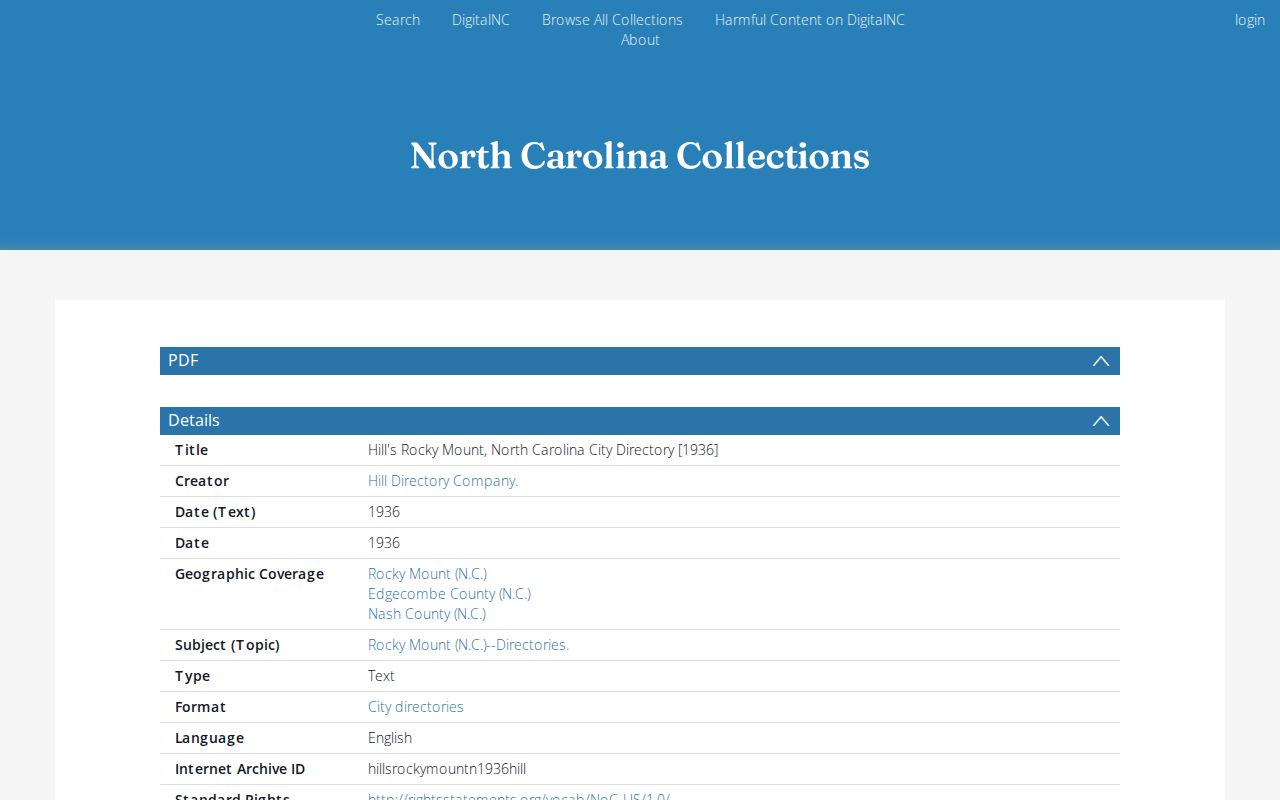
Use the catalog and the edition itself to establish what a particular volume contains before transferring its address evidence into a timeline.
Map Rocky Mount Past Residents Before Parcel IDs
For an address that predates the current parcel system, the 1896 Library of Congress Sanborn sheet set can anchor streets, building footprints, property context, and building use. Rocky Mount has mapped years from 1885 through 1956. A Sanborn map is an insurance and fire map, not a deed or household record. Use it to test whether an old street, building, or industrial setting is plausible, then return to the deed description or directory for names.
Historic districts can offer another physical-context check. Rocky Mount’s historic districts and landmarks material describes Villa Place, Machaven, and other designated places. Neighborhood labels may be useful search variants, but they do not prove that a parcel is inside a current district or association.
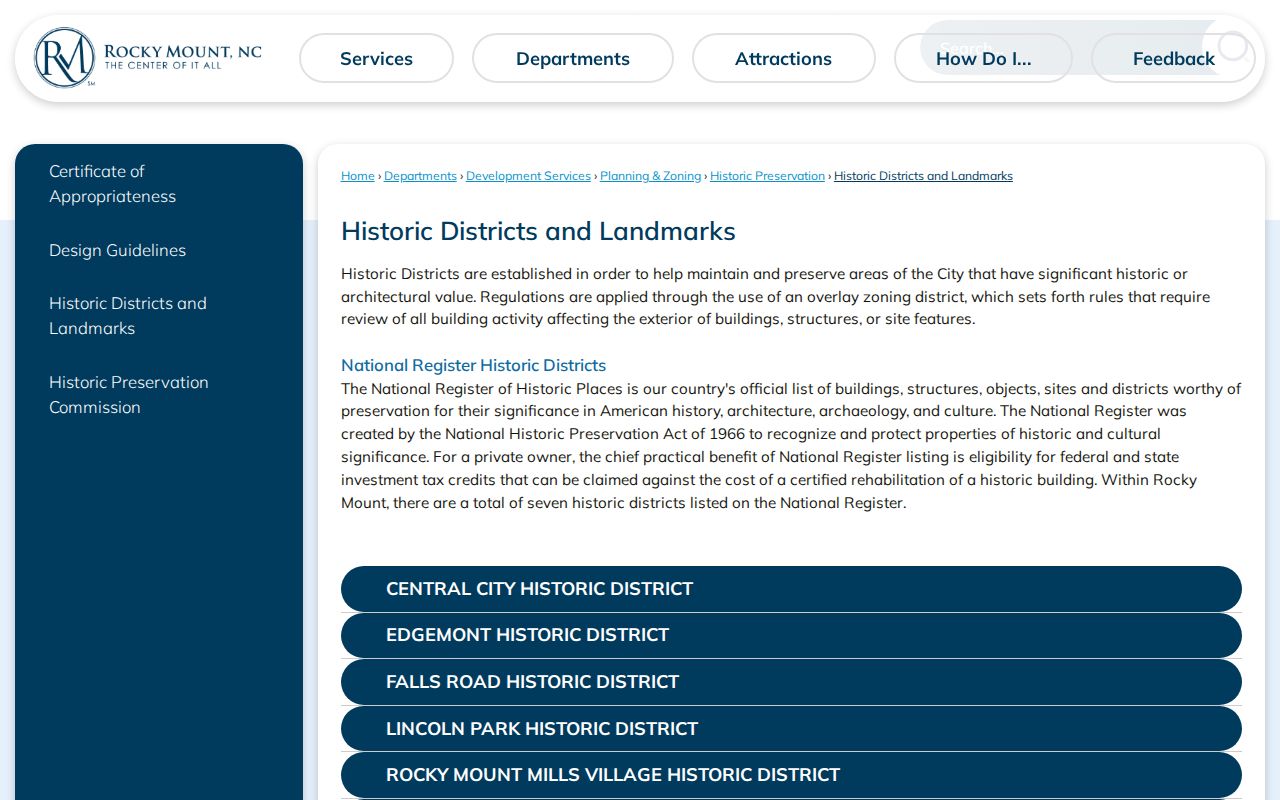
Pair the historic context with a deed, map, or directory date so the address history remains anchored in a specific record.
Track Rocky Mount Departure Clues
When a name disappears from a directory or deed sequence, newspaper and cemetery records may supply a lead, not a conclusion. The North Carolina Archives newspaper guide identifies Rocky Mount title runs including the Evening Telegram from 1937 to 1970 and selected later years, with 228 reels. Obituaries, legal notices, property sales, court notices, and civic notices can connect a date, relationship, or address. Newspaper statements are secondary and can contain errors.
Rocky Mount municipal cemetery records are another custodial route. Burial permits can join a decedent with residence or address, death place/date, plot, authorization, and funeral-home fields. Ask the cemetery office only for the necessary public or custodial information. The record is sensitive and should not be turned into a bulk address list.
The Archives newspaper guide is the source represented below for this previous-residents research step.
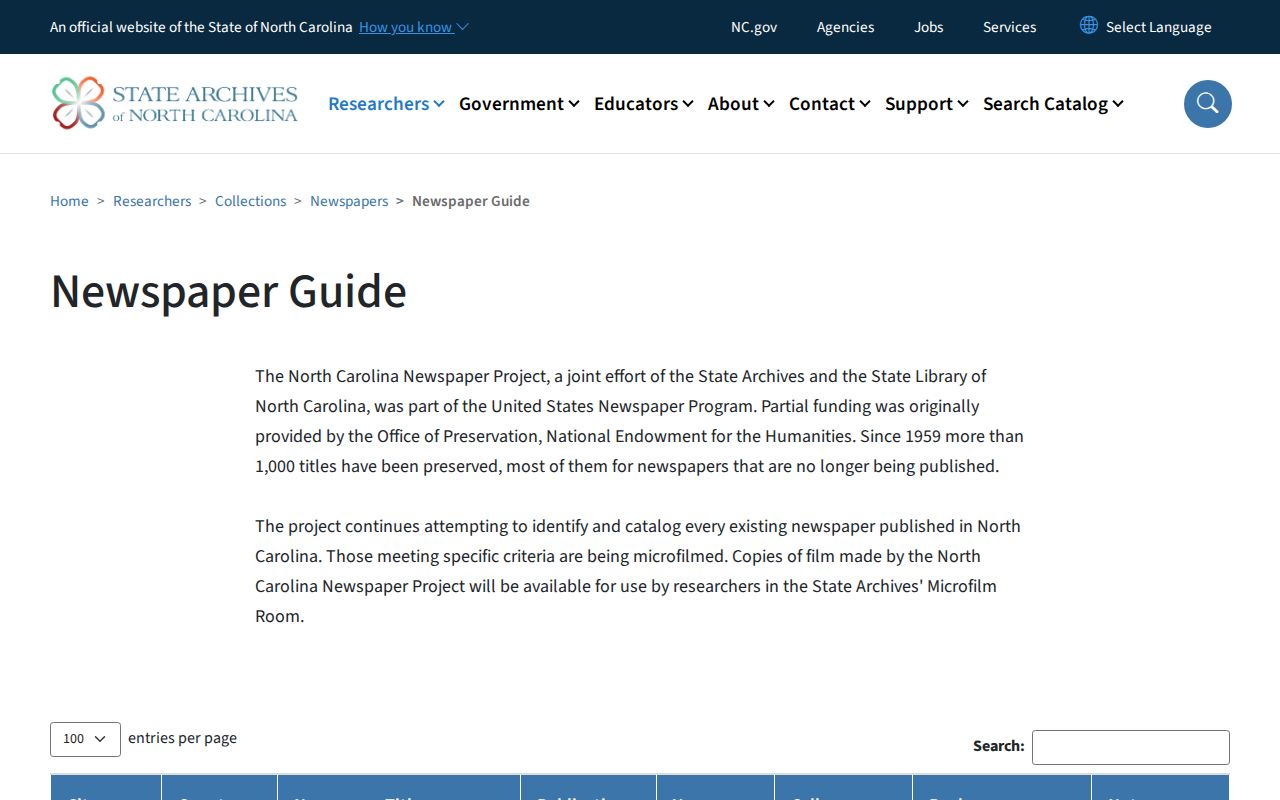
Check the title and reel date before treating a newspaper search as a complete run, because the guide describes holdings by title and coverage.
Label Rocky Mount Past Household Roles
Historical evidence becomes clearer when every name carries its source role. “Owner” belongs to a tax or deed field. “Grantor” and “grantee” belong to a conveyance. “Listed householder” belongs to a specific directory edition. “Roomer,” if the directory uses that term, is a source notation rather than a modern label. “Registered voter” belongs to a dated registration record. This discipline prevents a transaction party, tax addressee, or newspaper subject from being presented as a person who lived at the house.
City growth and boundary shifts also need dates. The Tar River and railroad shaped Rocky Mount’s development, and the city absorbed Rocky Mount Mills village in 1927 after its 1893 incorporation. Annexation can change municipal context without moving the historical county custodian. Compare old map, directory, deed, and current GIS descriptions when an address seems to shift.
Lawful personal use. Use past-resident research for house history, family history, estate questions, or personal curiosity. Do not use an address history to stalk, harass, intimidate, or harm a living person.